
Shengtai Wenming
Part 1: How the vision of Ecological Civilization Entered the Chinese Constitution

It has been a few quiet weeks here. I return with a three-part post, published in the coming three weeks. Back in December, I gave a presentation on China’s Ecological Civilization (in Stockholm, at a gathering of the 4D Community (Dreamers, Doers, Designers and Doubters). I’ve decided to publish the script, in three parts over the coming weeks. First, the historical and political context. Then the philosophical roots and governance logic. Finally, questions it raises for the rest of us. Today, we begin at the beginning.
When you think about China in 2025, you are probably more likely to think of something like this. This is in Shenzhen, the newest of the new cities. In the middle of Shenzhen there is a huge museum about the recent history of the city. Inside that museum is a 75-meter-long LED screen, super high definition, absolutely beautiful.
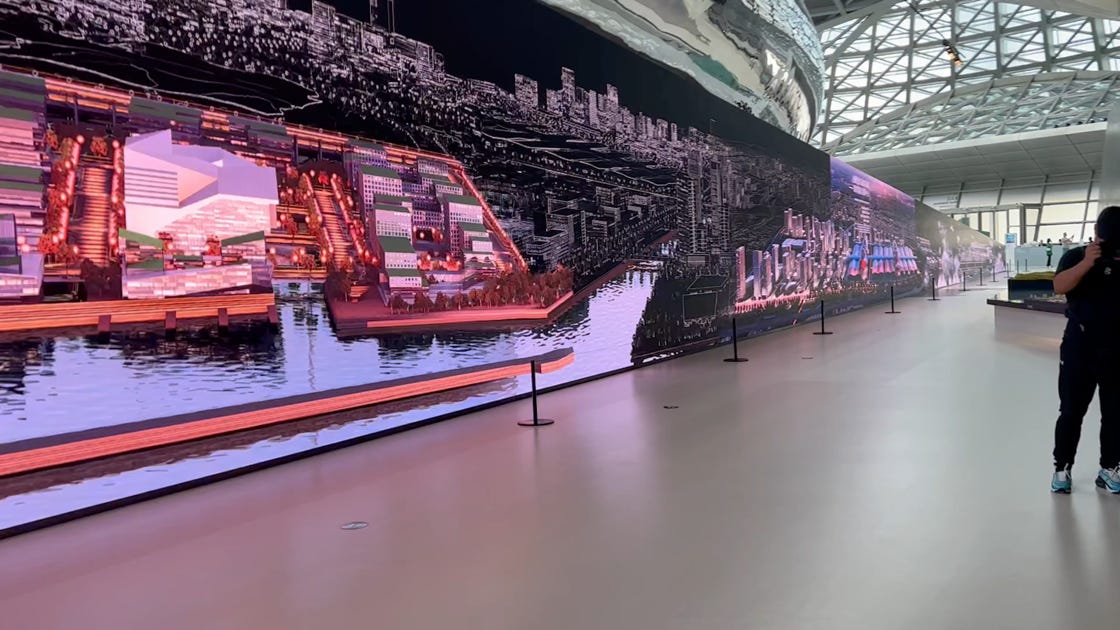
You step outside and Shenzhen is this vast, dazzling, hyper modern city. It does not exactly look like ecological civilization. And yet, underneath all of this, something else may be brewing. That is what I want to share with you.
For those of you who read Chinese, you can see what is written here on the slide. I will come back to it. It says, “Ecological Civilization”. Before talking about ecology and geopolitics and technology and policy, I think we should begin with language, with words, because words matter. Words shape imagination.
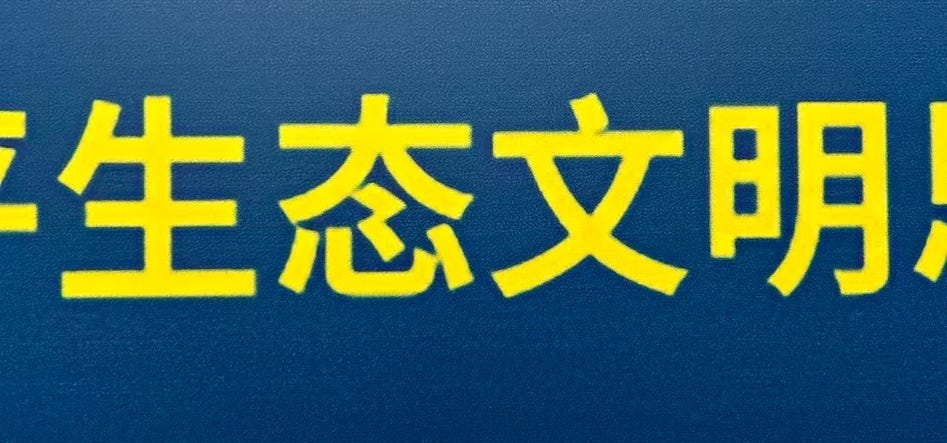
The words here are shengtai wenming. It is not only a label. It is four characters that carry a lot of meaning. I do not speak Chinese, but over the years I have learned that Chinese as a language is perhaps a hundred times richer than our languages when it comes to the layers of meaning that each character carries. I think it is important to remember that. So I wanted to begin with a short explanation of what this term points to.
I did this by asking one of my closest Chinese friends, Wang Wei (her English name is Alice Wang) to unpack the words for us. Let me summarize a few seconds of what she says.
“There are four characters. Two refer to “ecological” and two refer to “civilization”. Sheng and tai together form shengtai. Sheng means life, birth, life force, vitality. Tai means a state, a condition, a process. You could say tai refers to a process of evolving. So shengtai is the process of something emerging, of life being created and unfolding.”
Isn’t that word a little different and richer than “ecology” or “sustainability”? I think we should bear this in mind.
Now, shengtai wenming is nowadays translated as “ecological civilization”. In our part of the world, we do not really use the term “ecological civilization” as our overriding narrative. Indeed, for the past few decades we have really focused on the words “sustainable development”. That has been, I would argue, the guiding vision, the prevailing narrative, and the explicit attempt to reconcile growth and the planet, or economy and ecology, humanity and the Earth.
In a way it rests on an impossible compromise, an attempt to bring two opposing forces together, the forces of the economy and the forces of the planet. When I was young, we did not use the word “development” very much. The word we used was “progress”. Then, some time during my youth, that word faded away and we began to talk about development, and then much more about growth.
Progress, development, growth. And growth was supposed to be sustainable. But growth remained the nonnegotiable central objective. Ecology, well-being, harmony, all that was something external.
The same was of course true in China. Economic development was pursued and achieved at an incredible speed and at a scale that can be described as pharaonic. Like the pyramids, only larger.
Why was this? It was to achieve a vision of modernization and poverty reduction. The slogan of the 1990s was “development is the overriding principle”. Deng Xiaoping used that phrase in a speech in 1992 in Shenzhen, on a hill above the museum where that huge LED screen now sits. It was there, in 1992, that he spoke about China needing to begin a process of modernizing, opening up to the world, and launching what has turned into more than forty years of extraordinary economic growth, no doubt the most remarkable growth story the world has ever seen.
“Development is the overriding principle.” China compressed what we did over two hundred or three hundred years into maybe forty. The results are astounding. Almost nine percent yearly growth for about forty years. Around eight hundred million people lifted out of poverty. During my lifetime (soon 60 years), life expectancy has increased by over 20 years (from 54 to 78 years) and literacy has gone from about 50% to 97%. Hundreds of millions have moved into cities. If you look at any statistics from the last twenty or thirty years, or if you have travelled to China over this period, you know what I mean. What it was like twenty or thirty years ago, and what it is like today, can feel like different planets.
I don’t know about you, but I love trains. Over the last two decades China has built something like 50.000 kilometers of high-speed rail. That is about five times more than what we have in Europe. Look at a map and you see that China is not much larger than Europe, yet the scale of the infrastructure is enormous.
Naturally, in this context of very rapid economic growth, ecology suffers. The destruction of the environment in our part of the world took place over centuries, in China over a few decades. The faster the economic growth, the more ecology suffers. Development successes and ecological crises have unfolded side by side, at that same breathtaking speed.
If you visited Beijing fifteen or twenty years ago, you may remember that you were encouraged to check the US embassy website every morning for the air quality index (there were no apps in those days). Some days it was so bad that schools closed. If you went outside the city, the countryside was littered with plastic bags and garbage. Rivers turned black. Soils were degraded. Growth came at the expense of the planet, with serious costs for everything.
This is the context in which the idea of ecological civilization started to emerge. The roots go back to the 1990s, initially in academic circles. Then, as environmental damage became so severe that activists were pushing the authorities to act, they saw that it was not enough to deal with local problems. You also needed an overarching vision.
That vision became what we now call shengtai wenming, ecological civilization.
A friend of mine, another Chinese colleague called Zhou Tao, works at a large think tank, the Chinese Society for Environmental Sciences (120.000 members!). I have heard Zhou Tao give very good presentations on Chinese ecological civilization, so I have borrowed a couple of his slides. He traces its evolution back to the 1980s and 1990s, and he breaks down some of its components:
President Xi’s personal experience and thinking
Ecological wisdom in traditional Chinese culture
The theory and practice of eco-civilization construction
Marxism thought on the relationship between humans and nature
Experience and achievements of global sustainable development.
Part of the narrative, part of the official story, is the central role of President Xi, partly because this is China and that is how things are framed, but also because he does have genuine ecological credentials throughout his (tough) youth and long career, where nature and ecology played an important role for him. Already about twenty years ago he coined a phrase that is still very widely used: “Clear waters and green mountains are treasures beyond mountains of gold and silver”. In English it sounds awkward, but in Chinese it is very beautiful. This is sometimes called the “two mountains theory”, and you still hear a lot about it today.
Ecological civilization received nourishment from several sources. It was linked to traditional Chinese culture. It was linked to theory and to practice, to what was happening on the ground in the fight against pollution. It was woven into the evolution of Chinese Marxist thought. And it has been used as a theme in China’s international diplomacy.
Under the current leadership, over the last fifteen years, it has been written into foundational documents from the two most important power systems in China. First, in 2012, into the constitution of the Chinese Communist Party. Then, five or six years later, it was written into the State constitution, where the National People’s Congress added the line that “the state shall promote the building of an ecological civilization”.
Next week, Part 2: We move from doctrine to architecture. What does it mean when an ecological vision is embedded in constitutions, planning systems, performance metrics, and industrial strategy? We will look more closely at the policy scaffolding, the white paper, the pillars and beams, and the operating logic taking shape.